Home › School bus blog › RFID on the bus, UHF at the gate: how school attendance flows
RFID on the bus, UHF at the gate: how school attendance flows
Schools often ask whether they need RFID or UHF. Usually the answer is both, in different places. Here is how one student moves through a morning, and what each reader records.
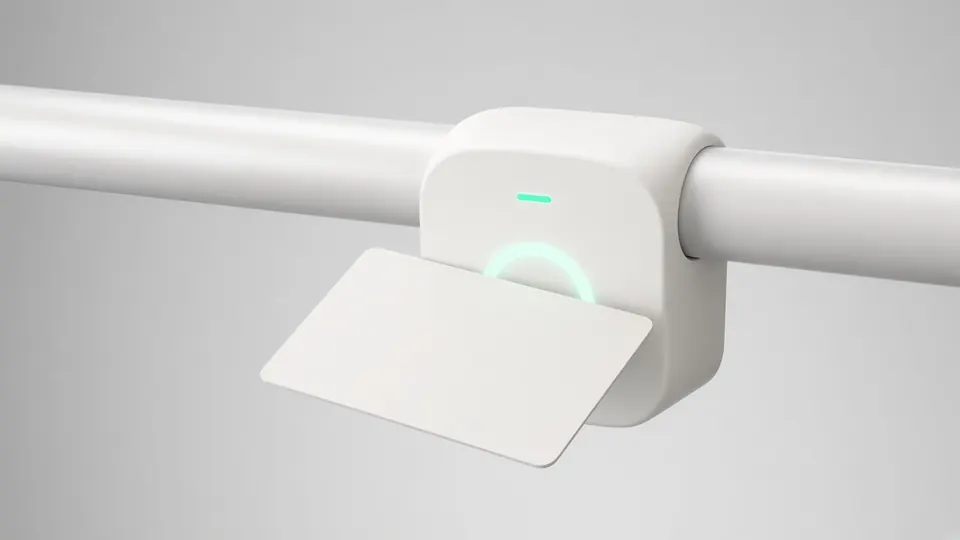
Related product: RFID attendance system for schools
Attendance used to mean a teacher calling names in the first period. Today, for schools that run buses, the question starts earlier: did the child get on the bus, did they get off at school, and did they walk into class? Two kinds of reader answer those questions in different places. RFID card readers suit the bus, and UHF readers suit the gate and classroom. This guide follows one student through one morning to show how the two work together.
RFID and UHF in one paragraph each
RFID card reader (on the bus). The student carries an RFID card, often built into the school ID card. A reader is mounted on the handrail by the bus door. The student taps the card when boarding and when getting off. One student taps at a time, which suits a bus door, where children board in single file anyway.
UHF reader (at the gate or classroom). The student carries a UHF tag, often also in the ID card. A reader at the gate or classroom door detects the tag as the student walks past. There is no tap, no stopping and no queue. That suits a school gate, where hundreds of students arrive in a short window.
One student, one morning
Meet Aarav, in Class 4, who takes Bus 7 from his housing society.
6:55. Bus 7 starts its route
The driver opens the driver app. The trip loads with the list of assigned students in pickup order. Aarav's name is on it. His mother applied for leave yesterday for his sister, so his sister's name is marked absent. The 4G GPS tracker begins reporting the bus location about every 5 seconds.
7:18. The parent alert
Bus 7 is about 2 km from Aarav's stop. His mother gets an alert on the parent app and they head down. No phone call to the driver, no waiting at the gate.
7:24. Aarav boards: the first record
Aarav taps his ID card on the handrail reader as he climbs in. In that moment:
- the tap is logged against Bus 7's route, with the time and stop;
- the attendant's list in the driver app shows Aarav as on board;
- his mother's app shows that he boarded;
- the transport manager's dashboard counts him in.
If the school has switched on SMS or app alerts, his mother gets one of those too.
7:51. Bus 7 reaches school: the second record
Aarav taps off as he gets down. His trip record is now complete: on at 7:24, off at 7:51. His mother's app shows the drop.
7:53. Aarav walks through the gate: the third record
The school has UHF readers at the main gate. Aarav walks through with his ID card on its lanyard and the reader picks up his tag. He does not stop or tap. The school office now knows he is on campus.
8:00. The office checks the lists
Before first period, the office compares three lists: who boarded the buses, who got off at school, and who came through the gate. Most days they match. When they do not, the gaps tell the office exactly where to look:
| What the records show | What it probably means | What to do |
|---|---|---|
| Expected on bus, no boarding tap, no leave | Child missed the bus, or forgot the card | Call the parent |
| Boarded, no drop tap | Forgot to tap off, or still on the bus | Check the bus and the gate record at once |
| Dropped, not seen at the gate | Went somewhere else on campus, or tag not read | Check with the class teacher |
| Seen at the gate, not on the bus | Came by car or on foot | No action |
Why not use one type of reader everywhere?
You could, but each type suits its place better.
- On the bus, children board one at a time through a narrow door. A tap is natural, and it gives a clear, deliberate record at a known spot. Satcop uses RFID card readers on the bus handrail.
- At the gate, hundreds of children arrive in minutes. Asking each one to stop and tap creates a queue. A UHF reader that picks up tags as students walk past keeps the line moving. Satcop uses UHF readers at gates and classrooms.
Both readers report to the same platform, so the school sees one attendance picture. Reports can be pulled by class, grade or date.
What each person sees
| Person | What they get |
|---|---|
| Parent | Attendance view in the parent app, plus SMS or app alerts where the school enables them. |
| Driver / attendant | Assigned students, in and out report, attendant attendance marking. |
| Transport manager | RFID attendance on the central live dashboard, with visited and missed stops. |
| School office | Reports by class, grade or date, ready for school systems. |
Practical questions to settle before you start
- Cards. Can the RFID chip and UHF tag go into the ID card students already wear, or are new cards needed?
- Forgotten cards. What does the attendant do when a child has no card? Agree a manual step, and ask any seller how their system records it.
- Reader placement. Which gates and classrooms get UHF readers? Large campuses with several entrances need a reader at each one that students use.
- Parent alerts. Which alerts will the school switch on, and is there a charge for SMS?
- Access. Who in the school can open student attendance records?
- Reports. Which reports does the office need, and how will they reach the school's own software?
Rolling it out at your school
Most schools start with the buses. Fit an RFID reader on every bus, issue or update the cards, and run a week where the attendant still keeps a paper list alongside the taps. That week shows up forgotten cards, children who tap twice and stops where boarding is rushed. Once bus attendance is steady, add UHF readers at the busiest gate, then at the other gates or classrooms. Tell parents what they will see in the app before the first day, so the first alert is not a surprise.
The limits
A reader records a card or a tag, not a child. A student who hands his card to a friend creates a false record. A reader at the gate does not know where a student goes once inside. Attendance technology makes records faster and more complete, but it works alongside staff, not instead of them. The attendant still checks the bus after every trip, and the class teacher still knows who is in the room.
Next steps
For product details, see RFID attendance for schools and UHF attendance at the gate. To see how attendance fits with live GPS, parent alerts and cameras, read about Satcop's school bus tracking system.
Frequently asked questions
What is the difference between RFID and UHF attendance?
With RFID, the student taps a card on a reader, as on the handrail reader on a school bus. With UHF, a reader at a gate or classroom detects the student's tag as they walk past, with no tap.
Can the same ID card carry both?
RFID and UHF credentials are often built into the school ID card. We confirm what your school would use at the demo.
Do parents see when the child boards the bus?
Parents get an attendance view in the parent app, and SMS or app alerts where the school enables them.
What happens if a child forgets the card?
Agree a manual step with the attendant in advance, and ask how the system records it. A reader can only record the cards it sees.
More guides
Want to see it on your buses?
Share your school, city and bus count. We will WhatsApp you back.
Let's talk.
We visit and demo in your city. Ask for a quote.
WhatsApp +91 91560 88090 · Head Office · Nyati Enthral, Kharadi, Pune 411014