Home › School bus blog › School bus tracking in Delhi NCR: a guide for schools
School bus tracking in Delhi NCR: a guide for schools
One school, five cities. NCR school buses cross between Delhi, Noida, Gurugram, Ghaziabad and Faridabad every day, through fog in winter and heavy traffic all year. Here is how to plan for it.
Related product: school bus GPS tracking in Delhi
Delhi NCR is not one city for school transport. It is five, joined by borders that buses cross twice a day. A school in South Delhi may carry students from Noida and Faridabad. A Gurugram school may run routes into Delhi's western colonies. A Ghaziabad school may pick up from East Delhi. Each city has its own road layout, its own traffic patterns and its own mix of colonies, sectors and high-rise societies. This guide looks at what that means for a school bus tracking system, and how transport teams across the region can plan for it.
Five cities, five patterns
| City | Typical school transport pattern |
|---|---|
| Delhi | Large multi-route campuses, colony gate pickups, Ring Road and arterial traffic, routes into all neighbouring cities. |
| Gurugram | New sectors and gated societies along Golf Course Extension, Sohna Road and the Dwarka Expressway. Routes change often as towers are handed over. |
| Noida | A regular sector grid, high-rise societies in Greater Noida West and along the expressway, and routes into East Delhi. |
| Ghaziabad | Dense townships such as Indirapuram, Vaishali and Raj Nagar Extension, with border crossings into East Delhi and Noida. |
| Faridabad | One long corridor along Mathura Road from Badarpur to Ballabgarh, with Greater Faridabad growing across the canal. |
Challenges that run across the region
Border crossings
Every border point, whether into Noida, Gurugram, Ghaziabad or Faridabad, is a likely spot for delay. Traffic at these points can change a great deal from day to day. For parents at the far end of a cross-border route, the timetable is a guess, and a live ETA is what they need.
Winter fog
In December and January, dense morning fog slows traffic across the region. Buses run late, sometimes very late, and schools sometimes change timings for the winter. Fog also makes it harder for drivers to see stops and turnings, so wrong turns become more likely.
Big fleets
Many NCR schools run large fleets. When a campus has dozens of buses, a transport office cannot track them by phone. It needs one screen showing every bus.
High-rise pickups
In Gurugram, Noida and Ghaziabad especially, many children live high up in large societies. Without an early warning, a child arrives at the gate after the bus, or waits in the cold far too long.
What the system should do in NCR
- Track across borders without a break. The tracker on the bus reports the same way whichever city it is in. Satcop's 4G tracker refreshes about every 5 seconds.
- Alert by distance, not timetable. When fog or a border jam delays a route, a timetable-based alert fires at the wrong time. An alert when the bus is about 2 km from the stop stays right.
- Flag wrong turns. In fog, or when a driver tries a shortcut to avoid a jam, staff should get a wrong-direction alert.
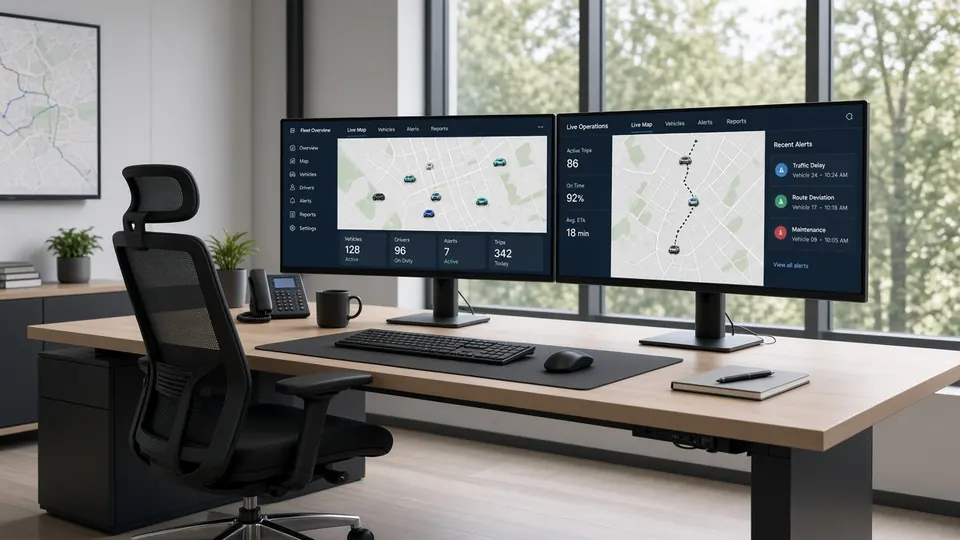
- Give the office one screen. The transport manager needs a live dashboard of every bus, every pickup and drop point, and visited and missed stops.
- Reach every parent at once. When winter timings change, one announcement in the parent app is better than fifty phone calls.
- Record every boarding. On long cross-border routes, an RFID tap on and off gives the school a clear record for every child.
A winter plan for NCR transport teams
- November: review last winter's trip history. Which routes ran latest in fog? Which stops were missed most? Consider moving pickup points off dark side roads onto better-lit main roads.
- When timings change: announce through the app, with the date the change starts, to all parents at once.
- Every foggy morning: watch the dashboard for the first half hour. Wrong-direction alerts show which drivers have strayed. Late routes show where parents may need a message.
- Cameras: on dark mornings, cabin cameras with IR night vision keep recording clearly. A dashcam records the road in poor visibility, which helps if there is an incident.
- After each foggy day: check missed stops and follow up any child who was expected but not recorded as boarding.
Managing a large, multi-city fleet
For schools with many buses, the tracking system becomes a transport management system. Useful tools include allocating or changing a student's bus when a family moves from one city to another, tracking vehicle documents and their expiry dates, keeping maintenance records, and reviewing trip and running costs. Route reviews matter more in NCR than almost anywhere. New sectors in Gurugram, Noida and Greater Faridabad fill up every year, and last year's routes quickly go stale. See school transport management system and route optimisation software.
Attendance across the region
An RFID card reader on the bus handrail records each child boarding and getting off, and the parent app shows it. UHF readers at the school gate record campus arrival without a queue, which matters when many buses arrive together. Comparing the two shows any child who got off the bus but did not reach class. Read how RFID and UHF attendance flow.
Questions to ask providers in NCR
- Does tracking work the same in every NCR city, with no gaps at the borders?
- Is the parent alert based on distance or a fixed time?
- How does the office see every bus at once?
- Can the school send one announcement to all parents, or to one route?
- Can a student's bus be changed quickly when they move?
- Who installs the devices, and how quickly can they return to fix a fault?
- What exactly does the quote include? See the 10 price factors.
Who does what in an NCR transport office
A big NCR fleet works best when roles are clear. The transport manager watches the dashboard during the morning and afternoon runs, handles wrong-direction and SOS alerts, and sends route announcements. A coordinator for each city cluster, for example one person for the Noida and Ghaziabad routes and one for Gurugram and Faridabad, knows the local roads and follows up missed stops. The school office owns attendance follow-up and parent calls. Drivers and attendants own the depot checks, the pickup order and the seat check after every trip. Write this down and share it, so that on a bad fog morning nobody assumes someone else is watching the screen.
Satcop in Delhi NCR
Satcop India is headquartered in Kharadi, Pune. We serve schools across Delhi NCR and travel to them to demo, install and train. We design and manufacture the tracking hardware in India and install it ourselves. Our school bus product runs at 200+ schools, on 10,000+ buses, for 200,000+ students. Start with school bus GPS tracking in Delhi, or go to the page for your city above.
Frequently asked questions
Does school bus tracking work across Delhi NCR borders?
Yes. A GPS tracker on the bus reports the same way in every city, so a route from Noida to Delhi or from Delhi to Gurugram shows as one continuous trip.
How do parents cope with fog delays?
A live map with an ETA, plus an alert when the bus is about 2 km from the stop, lets parents time the pickup even when the timetable slips.
Can one dashboard show buses in several NCR cities?
Yes. The transport manager dashboard shows every bus, wherever it is, along with pickup and drop points and visited and missed stops.
Does Satcop install in Noida, Gurugram, Ghaziabad and Faridabad?
Yes. We travel to schools across Delhi NCR to demo and install.
More guides
Want to see it on your buses?
Share your school, city and bus count. We will WhatsApp you back.
Let's talk.
We visit and demo in your city. Ask for a quote.
WhatsApp +91 91560 88090 · Head Office · Nyati Enthral, Kharadi, Pune 411014