Home › School bus blog › GPS Device or Driver Phone? Choosing How to Track School Buses
GPS Device or Driver Phone? Choosing How to Track School Buses
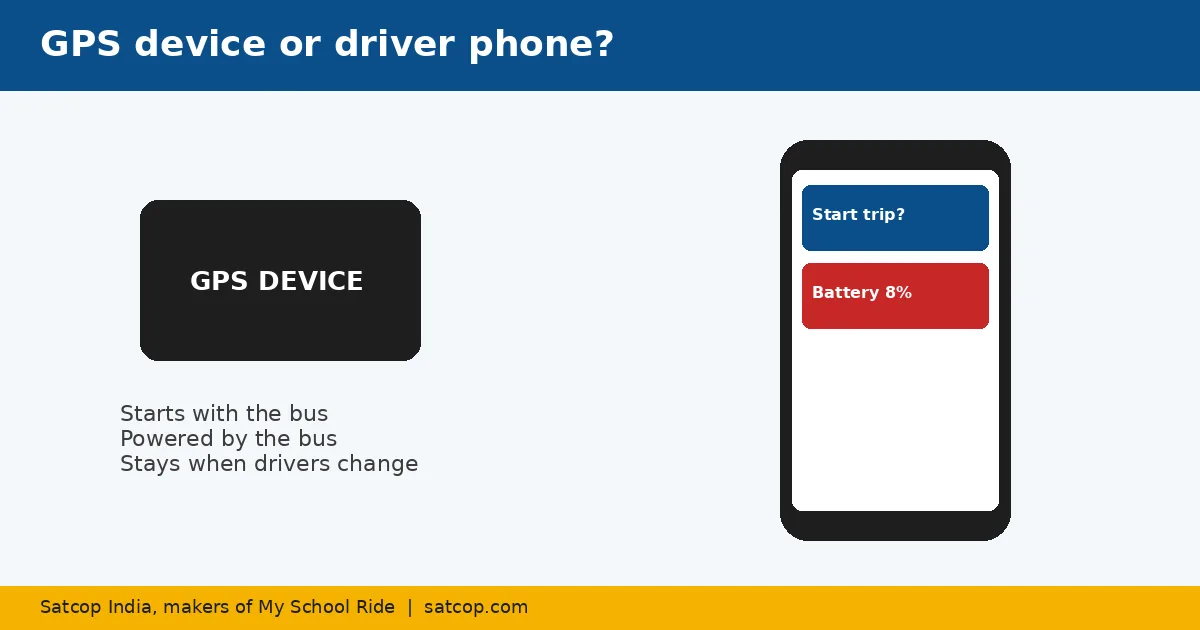
There are two ways to put a school bus on a map. One uses a fixed GPS device wired into the bus. The other uses an app on the driver's or attendant's phone. Both can show a moving dot to parents. The difference shows up on the days that matter: a dead phone battery, a driver on leave, or a bus that leaves the depot without anyone opening the app.
Related product: school bus GPS device
My School Ride already has a side-by-side phone vs GPS device comparison. This post looks at the decision differently: reliability over a whole school year, and the total cost of running each option.
How each option works
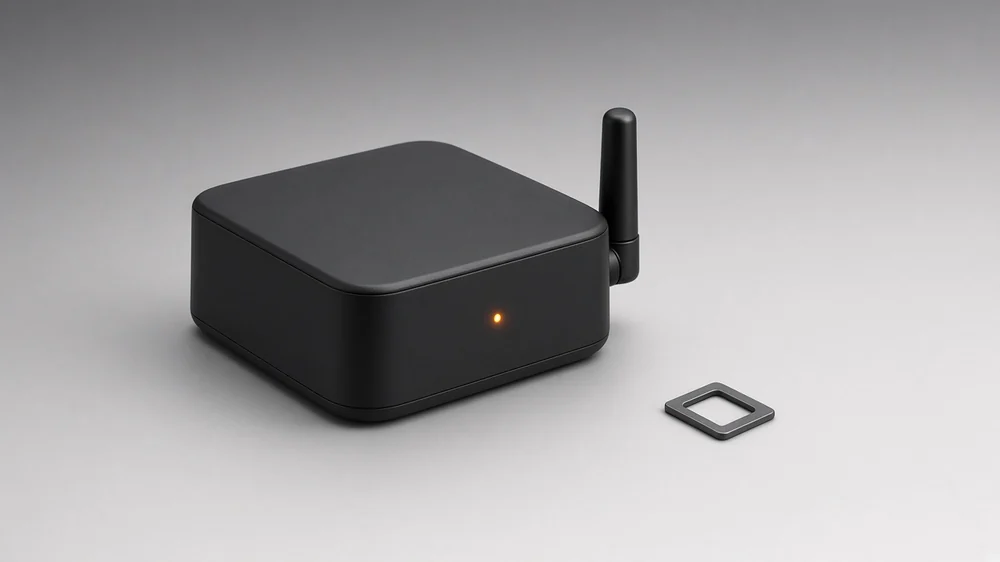
Fixed GPS device. A small tracker is installed in the bus and powered by the vehicle. It reports location by itself whenever the bus is running. Nobody has to remember to start it. See our school bus GPS device.
Phone-based tracking. The driver or attendant logs into an app at the start of each trip. The phone's GPS and mobile data send the location. It works as long as the phone is charged, online, and the app stays open.
Reliability: the question that matters most
Think about a full school year and every bus in your fleet. Ask: on how many of those trips will something go wrong?
With phones, the common failure points are: - the phone battery runs down on a long route; - the driver forgets to start the trip, or the app is closed to take a call; - a substitute driver does not have the app; - the phone is the driver's personal property, so the school cannot control it.
With a fixed device, the common failure points are: - a loose wire or power issue after a repair; - a SIM or network problem in a weak-signal area.
Device failures are rarer and easier to spot on a dashboard, because the device reports by itself. With phones, every trip depends on one person remembering.
Total cost of ownership
The first quote is not the full cost. List these for both options:
| Cost item | Fixed device | Phone-based |
|---|---|---|
| Hardware | Device per bus plus installation | A phone per bus (or reliance on the driver's own phone) |
| Data | Device SIM | Phone data plan |
| Staff time | Low: starts itself | Daily: someone must start and monitor each trip |
| Missed trips | Few | More, especially with driver changes |
| Parent trust | Higher when the dot is always there | Drops after a few "bus not showing" mornings |
The cheapest-looking option can cost more once you count office time spent answering parents on days when tracking failed. Ask for a quote for your fleet so you can compare like with like.
When a phone can make sense
- A pilot on 1 or 2 routes before buying devices.
- A temporary hired bus for a trip.
- As a backup for the attendant to mark attendance and send SOS from the app.
Many schools end up with both: a fixed device for location, and a driver or attendant app for attendance and alerts.
Questions to settle before you choose
- Who owns the phone, and what happens when the driver changes?
- Will the system still track if nobody opens an app?
- How will you know a bus has gone offline, and how fast?
- Can it record trip history for later review?
- Does it work with RFID bus attendance and cameras later?
- Who installs and services devices in your city?
Different cities, same answer
In cities with long, traffic-heavy routes, such as Mumbai, Delhi NCR, Bengaluru, Hyderabad and Chennai, phone batteries and app interruptions cause more gaps. In growing cities like Pune, Ahmedabad, Jaipur, Lucknow, Indore and Surat, schools often start with phones and move to devices as their fleet grows. Planning for devices from the start avoids paying twice.
Satcop India designs and makes its trackers in India. Our head office is in Pune (Kharadi) and we have an office in Hyderabad (Gachibowli). In every other city, we serve schools and demo on your buses.
Coverage and accuracy
Both approaches rely on GPS and mobile data, and both can lose signal in the same places. The difference is how they cope. A purpose-built tracker is designed to keep a fix and buffer data when coverage drops, and its antenna position on the bus is chosen during installation. A phone in a driver's pocket or on the dashboard can be less consistent, depending on the model and where it sits.
Support when something goes wrong
When a phone-based tracker fails, the first suspect is the phone, and the school ends up troubleshooting a driver's personal device. When a fitted tracker fails, the vendor owns the problem. Ask any vendor what happens when a device stops reporting, who checks it, and how quickly someone visits.
What parents notice
Parents rarely ask how a bus is tracked. They notice the result. A map that updates smoothly and an arrival alert that comes at the same point every day build trust within a few weeks. A map that freezes at the same junction, or a bus that vanishes whenever the driver takes a call, undoes that trust just as quickly, and the calls to the school office start again. Since reducing those calls is one of the main reasons schools adopt tracking, the steadiness of the location feed matters more than any single feature on a brochure. When you test any system, ask a few parents on the pilot route to note each day whether the map and alerts behaved as expected.
Attendance and other hardware
Location is only one part of school bus tracking. Many schools also want RFID card readers on the bus to record who boarded, and some want cabin cameras or dashcams. Those devices need a stable link to the bus's tracking system. A phone app can let an attendant mark attendance by hand, but it cannot read cards or record video by itself. With a fitted system, the RFID reader and cameras are part of the same set-up.
Our view
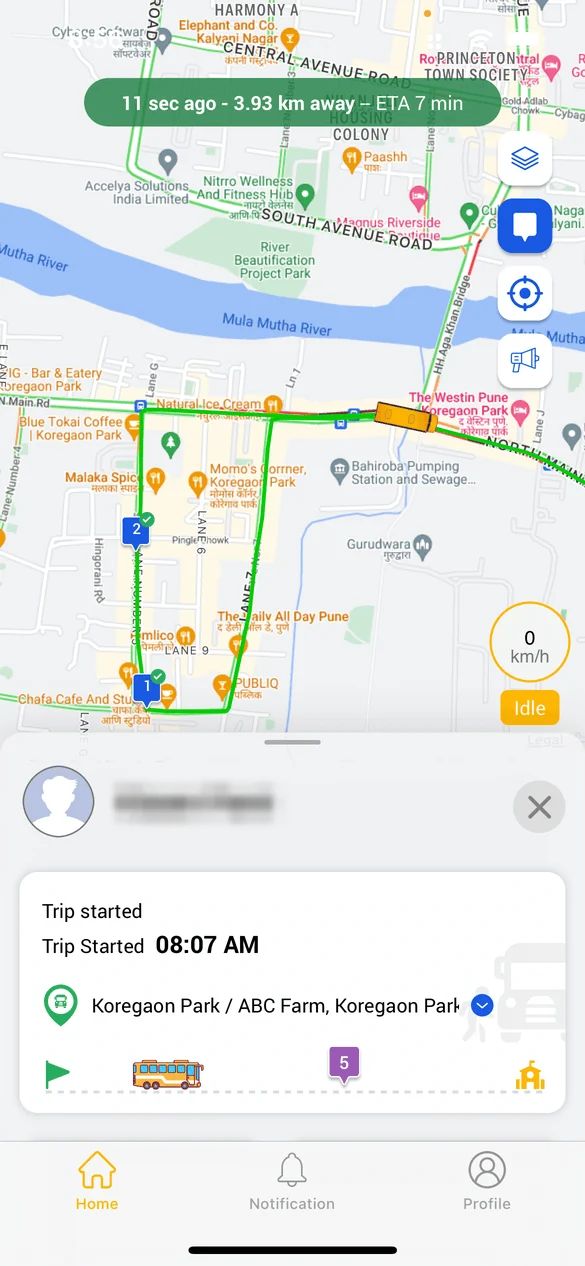
For daily school routes, a fixed GPS device is the reliable base, and an app for drivers, attendants and parents sits on top. My School Ride is that app, used by 200+ schools, 10,000+ buses and 200,000+ students. See the full school bus tracking solution.
Reliability checks during a pilot
If you are unsure, run both options side by side on two routes for two weeks. Each morning, note whether the bus appeared on the map from depot to school, whether any trip had gaps, and how many parent calls the office received. At the end, compare the logs. Most schools find that the numbers speak for themselves, and the comparison gives the committee a fact-based reason for its choice.
Frequently asked questions
Does school bus tracking need a GPS device or can it use a phone?
Both can work. A fixed device is more reliable for daily routes because it tracks automatically. A phone depends on battery, data and someone starting the app.
Is phone-based school bus tracking cheaper?
The upfront cost can look lower, but staff time, missed trips and parent calls add up. Compare total cost over a school year.
What happens if the driver changes?
With a fixed device, tracking continues because it belongs to the bus. With phones, the new driver needs the app and login.
Can we use both a device and an app?
Yes. Many schools use a device for location and an app for attendance, SOS and parent alerts.
How much does a school bus GPS tracking system cost?
It depends on bus count and features. Ask for a quote.
More guides
Want to see it on your buses?
Share your school, city and bus count. We will WhatsApp you back.
Let's talk.
We visit and demo in your city. Ask for a quote.
WhatsApp +91 91560 88090 · Head Office · Nyati Enthral, Kharadi, Pune 411014